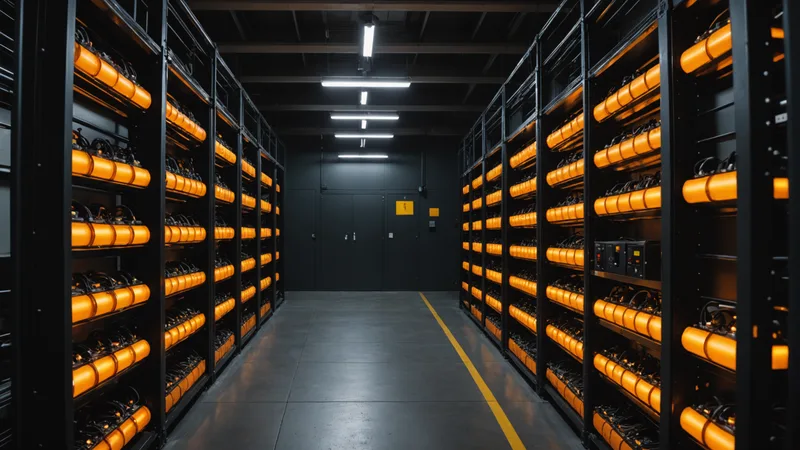
FCR — Frequency Containment Reserve, the German Primärregelleistung — is the fastest-responding ancillary service in the European grid. When grid frequency deviates from 50 Hz, FCR assets respond automatically within 30 seconds. Batteries are structurally well-suited for this: they can ramp at full power in under 100 ms. The Bundesnetzagentur and the four German TSOs (TenneT, 50Hertz, Amprion, TransnetBW) procure FCR capacity weekly via competitive tender on regelleistung.net. Commercial battery owners can participate — but the prequalification path and revenue arithmetic are less straightforward than vendors imply.
This post walks through the technical requirements, the tender structure, and what a 100 kWh system realistically earns. We're not claiming FCR is always the right choice — at certain price levels and with certain system configurations, EPEX spot arbitrage or peak shaving produces better returns. But FCR is a solid base-load revenue stream worth understanding precisely.
What FCR Actually Is
FCR is a capacity-based ancillary service. You get paid for being available — for having power ready to respond symmetrically to frequency deviations — not for the energy you actually discharge. This is a critical distinction. The FCR tender price is quoted in €/MW per week. A 100 kWh battery with a 1C rate has 100 kW of power. If you prequalify 50 kW of that capacity for FCR (the minimum tender lot is 1 MW, but you can pool with an aggregator down to smaller units), you earn based on that 50 kW availability figure.
Frequency response is proportional and automatic. Under the ENTSO-E FCR specification, the full 100% of prequalified power must be deployed when frequency deviates ±200 mHz from 50 Hz. Between 49.8 Hz and 50.2 Hz, the response is linear and symmetric — you charge when frequency is high (excess generation) and discharge when frequency is low (generation deficit). The battery's internal control system handles this autonomously; grid operator dispatch is not involved.
Prequalification Requirements
Prequalification is the formal process by which your battery is approved to participate in FCR tenders. The responsible party is your TSO (in Bavaria, typically TenneT or Amprion depending on grid connection point). The process takes 4–8 weeks and involves both documentation and a live technical test.
Documentation requirements
- Proof of metering class at the grid connection point (Zählerklasse, typically MID-certified billing meter)
- Remote controllability confirmation — the TSO must be able to send output setpoints via a certified communications link (usually IEC 61850 or AVACON/BDew protocol)
- Battery management system (BMS) documentation showing SOC state reporting to ±2% accuracy
- Technical data sheet confirming response time under 30 seconds from frequency trigger
- Signed grid operator network connection agreement
Live prequalification test
The TSO will schedule a 2–4 hour live test at your site. During this test, the TSO injects artificial frequency signals and verifies that your system responds correctly: proportionally, within the timing window, and symmetrically for both charge and discharge directions. The test also validates that your SOC management doesn't disable FCR availability — a common failure point. If your battery arrives at the test with 95% SOC, it cannot respond to high-frequency events (which require charging). You need to demonstrate that you maintain SOC in a range that allows both-direction response.
Most inverter manufacturers (Fronius, SMA, ABB, KACO) have developed pre-certified FCR firmware. This significantly simplifies the prequalification process since the frequency response algorithm is already type-approved. What still requires site-specific validation is the communications interface and the SOC management logic.
Tender Mechanics and Pricing
FCR tenders run weekly on regelleistung.net, with results published on Monday for the following week (Monday–Sunday). The market is a pay-as-cleared auction: all accepted bids receive the marginal clearing price (the highest accepted bid price). This means your bid strategy matters less than simply being below the clearing price — you don't lose revenue by bidding too low.
Minimum bid size is 1 MW of symmetric capacity. For commercial assets under 1 MW, aggregation through a Direktvermarkter (direct marketer / aggregator) is required. The aggregator pools your capacity with other assets to meet the 1 MW minimum, handles the tender submission and TSO communications, and typically charges 10–20% of FCR revenue as a service fee.
Historical price ranges
| Period | Weekly clearing price (€/MW/week) | Annualized (€/MW/year) |
|---|---|---|
| Q1 2023 | €2,800 – €5,200 | €145,600 – €270,400 |
| Q2–Q3 2023 | €1,400 – €2,600 | €72,800 – €135,200 |
| Q4 2023 | €800 – €1,800 | €41,600 – €93,600 |
| H1 2024 | €600 – €1,400 | €31,200 – €72,800 |
FCR prices fell sharply as more battery capacity entered the market in 2023–2024. The high prices of early 2023 reflected a capacity shortage — grid operators were willing to pay a premium. That premium has compressed. A realistic planning figure for 2025 is €800–€1,400/MW/week with periodic spikes during winter demand events. Anyone projecting €3,000+/MW/week as a steady-state FCR revenue assumption is using stale data.
Revenue Model: 100 kWh System
Let's work through a concrete example. Consider a 100 kWh LFP battery at a commercial facility in Munich — say, a mid-size logistics warehouse with a 500 kVA grid connection. The battery has a 1C charge/discharge rate, giving 100 kW of power in either direction.
For FCR, the prequalified capacity is typically 50% of the battery's power rating, because you need to reserve headroom for both charge and discharge response. You prequalify 50 kW symmetric. In MW terms, that's 0.05 MW.
Revenue calculation (2025 planning assumption)
| Parameter | Value |
|---|---|
| Prequalified FCR capacity | 50 kW (0.05 MW) |
| FCR clearing price (mid-range) | €1,000/MW/week |
| Weekly gross revenue | €50 |
| Annual gross (52 weeks) | €2,600 |
| Aggregator fee (15%) | –€390 |
| Net annual FCR revenue | €2,210 |
That €2,210/year is the FCR-only contribution. On its own, it does not justify a 100 kWh battery installation, which costs €80,000–€120,000 installed. The business case requires revenue stacking — FCR during lower-volatility periods, EPEX intraday dispatch when spreads are wide, and peak shaving all running simultaneously on the same hardware. That's the architecture we built encosa around, and why the control logic is more complex than a single-service optimizer.
SOC Management in FCR Mode
This is where most battery control systems fail in practice. FCR requires symmetric response capability at all times. If your battery SOC reaches 90%, you've consumed most of your headroom for charging response (high-frequency events that require you to absorb energy). If SOC hits 10%, you've lost discharge headroom. The TSO expects availability in both directions throughout the prequalified period.
The practical implication: your battery must maintain SOC in a band — typically 30–70% — during FCR service hours. This sounds straightforward but creates a conflict with spot market dispatch, which wants SOC at 5–10% before cheap charging windows and 90–95% before expensive discharge windows. You cannot satisfy both requirements simultaneously with a naive SOC target.
The approach we take is time-horizon segmentation. FCR capacity is committed in weekly blocks on a fixed schedule. The optimizer knows in advance which hours are under FCR obligation and reserves SOC headroom accordingly. In hours without FCR commitment (or during non-FCR weeks), the full battery capacity is available for spot arbitrage and peak shaving. The weekly tender structure actually helps here — because FCR is committed seven days ahead, the dispatch algorithm has a clean planning horizon to work with.
Limits and Tradeoffs
We're not saying FCR is wrong for commercial batteries — we're saying it should be evaluated against current market prices, not historical peaks, and factored into a multi-service optimization rather than treated as a standalone revenue source.
A few practical constraints to factor in:
- Degradation from shallow cycling: FCR operation produces many shallow charge/discharge cycles per day. LFP chemistry handles this well; NMC is more sensitive. Verify your warranty terms with the battery OEM before committing to continuous FCR service.
- Aggregator dependency: Below 1 MW you need an aggregator. This introduces counterparty risk and a fee drag that reduces net revenue. Evaluate aggregator contract terms carefully — especially exit clauses if FCR prices drop further.
- TSO prequalification renewal: Prequalification is not permanent. Changes to hardware, firmware, or grid connection require re-prequalification. Budget time for this if you plan hardware upgrades.
- Availability guarantees: You are contractually obligated to maintain FCR availability during committed periods. Planned maintenance must be scheduled in non-committed windows. Battery outages during FCR service periods incur penalties from the TSO.
The systems we work with at encosa typically run FCR in 2–3 week blocks per month and reserve other weeks for unconstrained spot and peak shaving dispatch. This hybrid calendar approach — rather than a fixed always-on FCR commitment — has produced better aggregate returns than pure FCR participation for sub-1 MW commercial assets at 2024–2025 FCR price levels. The right mix depends on your specific grid tariff structure, local electricity price exposure, and battery system specs. That analysis is what the encosa revenue calculator is built to handle.